
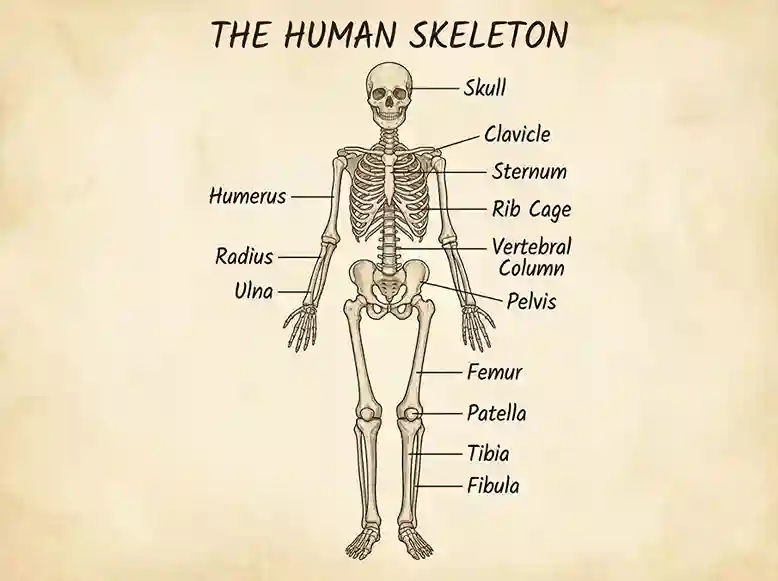
The human skeletal system is the strong structure of the body that is composed of various bones. An adult human body contains approximately 206 bones, which together provide the body with shape, support, and stability. These human skeleton bones are connected to one another through joints, ligaments, and cartilage. This enables flexibility and movement in the body. The human skeleton is primarily divided into two parts—the axial skeleton and the appendicular skeleton.
The human skeleton’s bones play a critical role in maintaining overall body function. This is due to the fact that the bones provide support to the human body while at the same time protecting vital organs. The skull protects the brain, while the ribs protect the heart and lungs. The bones in the human body, in conjunction with muscles, provide the required movement for the human body to carry out various activities.
The bone marrow in the human skeleton bones manufactures blood and stores minerals such as calcium and phosphorus. Therefore, healthy and strong bones are absolutely essential for good health.
Types of Human Skeleton Bones (Based on Shape)
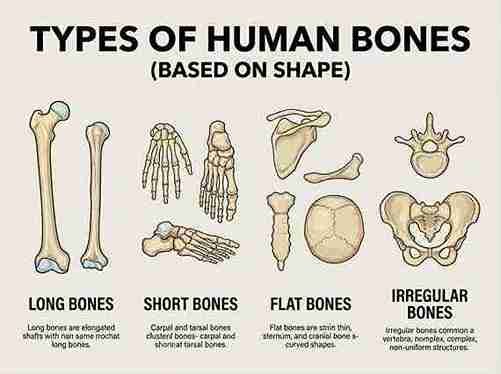
The human body contains a total of 206 bones, which are primarily classified into four categories based on their shape and function.
-
Long Bones
Long bones are greater in length than in width, and they help support the body and facilitate movement.
Ex: Femur, Humerus, etc.
-
Short Bones
These bones are small in size and roughly cube-shaped, helping to provide stability and balance to the body.
Ex: Wrist, ankle, etc.
-
Flat Bones
Long bones are slender and broad in shape, and their primary function is to protect the body’s internal organs.
Ex: Skull, ribs, sternum, etc.
-
Irregular Bones
The shape of these bones is irregular and complex; they are designed for specific functions.
Ex: Vertebrae
Types of Human Skeleton Bones (Based on Location)
-
Axial Skeleton Bones
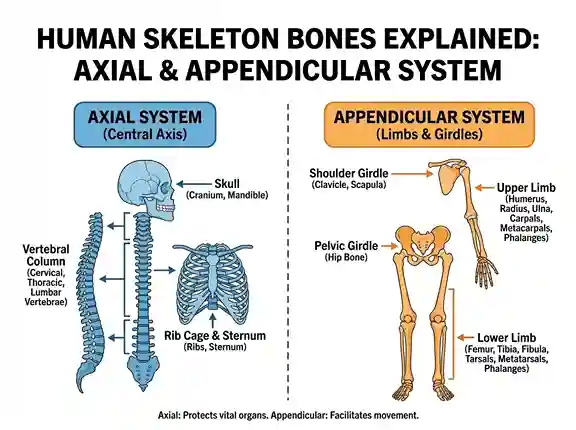
Axial skeleton bones are the bones that form the central part (central axis) of the body. These bones support the head, neck, and trunk and maintain the body’s balance. The axial skeleton consists of a total of 80 bones, which form the main structure of the body.
Main Parts of the Axial Skeleton
-
Skull
The skull is composed of several bones.
- It protects the brain.
- It forms the structure of the face.
-
Vertebral Column
The spine is also known as the backbone.
- It consists of a total of 33 vertebrae.
- It helps keep the body upright.
- It protects the spinal cord.
-
Rib Cage
The rib cage forms the framework of the chest.
- It consists of 12 pairs of ribs and a sternum.
- It protects the heart and lungs.
- It aids in breathing.
Functions of the Axial Skeleton
- Providing support and stability to the body
- Maintaining proper posture
- Protecting vital organs such as the brain, heart, and lungs
- Providing a base for muscle attachment
Appendicular Skeleton Bones
The bones of the appendicular skeleton are those that make up the body’s limbs and the parts connecting them to the rest of the body. This skeleton is primarily responsible for movement. The appendicular skeleton consists of a total of 126 bones.
Main Parts of the Appendicular Skeleton Bones
-
Shoulder Girdle
- It consists of the clavicle (collarbone) and the scapula (shoulder blade).
- It connects the arms to the body.
-
Upper Limbs
- It includes the hands and arms.
- Main bones: humerus, radius, and ulna.
- They help in grasping and lifting.
-
Lower Limbs
- It includes the legs.
- Main bones: femur, tibia, and fibula.
- They help with walking, running, and maintaining balance.
-
Pelvic Girdle
- It connects the legs to the body.
- It supports the body’s weight.
Function of Appendicular Skeleton Bones
- Providing movement to the body
- Assisting in actions such as walking, running, and lifting
- Maintaining body balance
- Working in conjunction with the muscles
Skeleton with Bones Labeled
Functions of Human Skeleton Bones
The bones in the human skeleton perform a number of significant roles for the human body.
- Support and Structure: The bones provide a structure to the human body, enabling a person to stand upright and giving the human body its shape.
- Protection of Organs: The bones in our human bodies protect the organs in our human bodies. For example, our skull protects our brain in our human body.
- Movement and Flexibility: Our bones work in collaboration with our muscles, which enables us to perform various activities such as walking, running, etc., and even sitting up from a lying-down position.
- Blood Cell Production: Our bone marrow, which is present inside our human body, produces blood cells in our human body.
- Mineral Storage: Our human body stores a lot of minerals in our bones, which are required by our human bodies.
Interesting Facts About Human Skeleton Bones
- A newborn baby is born with 300 bones, but as the child grows, the bones fuse together, and there are only 206 bones in the adult body.
- The femur, or thigh bone, is the longest and strongest bone in the body.
- The smallest bone in the body is the stapes, found in the ear.
- The percentage of body weight made up by the skeleton is 14%.
- Bones are stronger than steel, yet they are lightweight.
- The hands and feet combined contain more than half of the total bones found in the body.
- The bones are not hollow; they contain bone marrow, from which blood cells are made.
- The skull is made up of many bones fused together to enclose and protect the brain.
- The spine is flexible, allowing us to bend and twist.
- The bones are constantly breaking down and rebuilding, and therefore, the skeleton is living tissue.
- The human skeleton bones have the power of regeneration, i.e., they can heal themselves. If a bone is broken, then blood clots are formed, and then new tissue, called a callus, is formed, which later hardens to form new bone.
Join Our Yoga courses in Rishikesh | Mira Yogashala
- 100 Hour Yoga Teacher Training in Rishikesh
- 200 Hour Yoga Teacher Training in Rishikesh
- 300 Hour Yoga Teacher Training in Rishikesh
- 500 Hour Yoga Teacher Training in Rishikesh
Conclusion
The skeleton bones are the framework that gives the human body its structure, support, and protection. The skeletal system consists of two parts: the axial system and the appendicular system. These two parts work in conjunction to provide the human body with balance, posture, and movement. The bones in the human body protect vital organs such as the brain, heart, and lungs.
The bones also facilitate activities such as walking, running, and lifting through the muscles. Moreover, the bones are essential in the production of blood and the storage of vital minerals such as calcium and phosphorus. The ability to repair and regenerate damaged bones makes the human skeletal system dynamic and living. The human skeleton system gives one an appreciation for the significance and importance of the system in the human body.
FAQs
Ques: How many bones are in the axial skeleton?
Ans: 80 bones
Ques: How many bones are in the appendicular skeleton?
Ans: 126 bones
Ques: How many bones are in the human skeleton?
Ans: 206 bones
Ques: Which bone is part of the axial skeleton?
Ans: Skull, ribs, and vertebral column